Transport in plants
Contents: 8 sections
Xylem and phloem
Two separate transport tissues, carrying different things in different directions.
| Xylem | Phloem | |
|---|---|---|
| Carries | water and mineral ions | sucrose and amino acids |
| Direction | upwards only, root to leaf | both ways, source to sink |
| Cells | dead, hollow, no end walls | living, with sieve plates |
| Walls | thickened with lignin | thin, with companion cells alongside |
Xylem cells being dead is not a detail to skip. A dead, empty, open-ended tube offers no resistance to water flow, and the lignin gives the plant much of its support. Phloem must be alive because translocation needs energy.
Positions are asked from diagrams:
- Root — xylem and phloem in the centre, forming a star of xylem.
- Stem — vascular bundles near the outside, with xylem on the inside of each bundle and phloem on the outside.
- Leaf — in the midrib and veins, xylem above, phloem below.
The pathway of water
Learn it as one continuous route, because questions ask for it in order:
soil → root hair cell → root cortex → xylem → stem → leaf → mesophyll cells → evaporates → out through the stomata
Water enters the root hair cell by osmosis, because the soil solution has a higher water potential than the cell. The root hair cell is adapted for this with a long narrow extension giving a large surface area.
Mineral ions enter separately, usually by active transport, because they are more concentrated inside the root than in the soil. That is against the gradient and so needs energy, which is why root hair cells have many mitochondria.
Transpiration
Transpiration is the loss of water vapour from the leaves by evaporation and diffusion through the stomata.
Water evaporates from the surfaces of the mesophyll cells into the air spaces, then diffuses out through the stomata down a concentration gradient.
That loss pulls the whole column upward. Water molecules stick to each other by cohesion, so as one leaves the top, the whole chain is drawn up through the xylem. This is the transpiration stream, and it is a pull from above rather than a push from below.
Transpiration is not simply waste. It carries water to the leaves for photosynthesis, delivers mineral ions, keeps cells turgid so the plant stays upright, and cools the leaf as water evaporates.
What changes the rate
Every factor works through either the rate of evaporation or the steepness of the gradient.
- Higher temperature — faster. Water molecules have more energy, so they evaporate more readily.
- Lower humidity — faster. Drier air means a steeper concentration gradient between the leaf's air spaces and the outside.
- Higher wind speed — faster. Moving air removes water vapour from around the stomata, keeping the gradient steep. In still air the vapour builds up and slows diffusion.
- Higher light intensity — faster. Light makes the stomata open for photosynthesis, and open stomata let water out.
Light is the one worth being careful with: it acts indirectly, through the stomata, not by heating the leaf.
The potometer
A potometer measures water uptake, and uptake is used as an estimate of transpiration. It is an estimate rather than a measurement, because a small amount of the water taken up is used in photosynthesis and to keep cells turgid.
The shoot is cut and assembled under water, so no air enters the xylem and breaks the column. As the shoot transpires, an air bubble moves along the capillary tube, and the distance it moves in a set time gives the rate.
A hot, dry, windy day moves the bubble fastest; a cool, humid, still one moves it slowest.
Wilting
If water is lost faster than it is taken up, cells lose water and become flaccid. Without turgor pressure the cells no longer support each other and the plant droops.
Wilting is partly protective: as the leaves droop and the guard cells lose turgor, the stomata close, which cuts further water loss. The cost is that carbon dioxide can no longer enter, so photosynthesis stops.
Translocation
Translocation is the movement of sucrose and amino acids in the phloem, from regions of production or storage to regions where they are used or stored.
- A source is where the substance is made or released, such as a photosynthesising leaf in summer, or a storage organ in spring.
- A sink is where it is used or stored, such as a growing root tip, a developing fruit, or a storage organ in summer.
The same organ can switch roles with the season, which is exactly what questions test. A potato tuber is a sink in summer, when leaves send sugar down to be stored, and a source in spring, when that store is used to grow new shoots.
Because translocation requires energy from the companion cells, anything that stops respiration stops it, which is one way to tell it apart from movement in the xylem.
Check you have it
Question 1
Which row correctly states the pair of conditions that will result in the highest rate of transpiration? Each answer gives, in order: temperature; humidity.
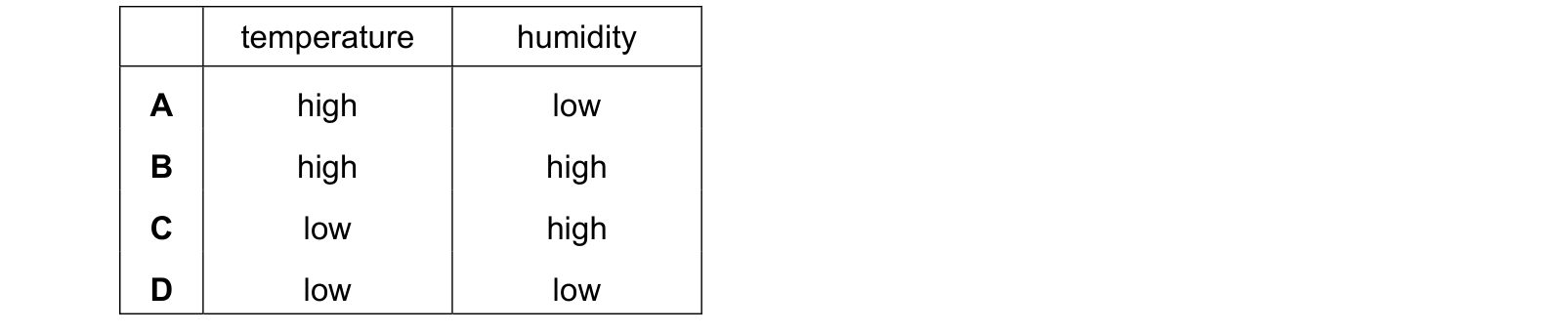
Answer: A.
The two act on different parts of the same process.
High temperature supplies more energy for water to evaporate from the mesophyll cell surfaces inside the leaf, and it speeds up the diffusion of the vapour that follows.
Low humidity means the air outside holds little water vapour, so the concentration gradient between the leaf's air spaces and the atmosphere is steep and vapour diffuses out quickly.
Humidity is the factor that catches people out, because it is the only one of the four where the transpiration-increasing direction is downwards. High wind speed, high temperature and high light intensity all increase transpiration; high humidity reduces it.
In still, humid air the vapour accumulates around the stomata and the gradient almost disappears, which is why plants in a greenhouse lose far less water than plants in a dry breeze.
Question 2
Which row shows the transpiration rate for the conditions described? Each answer gives, in order: wind speed; atmospheric temperature; transpiration rate.
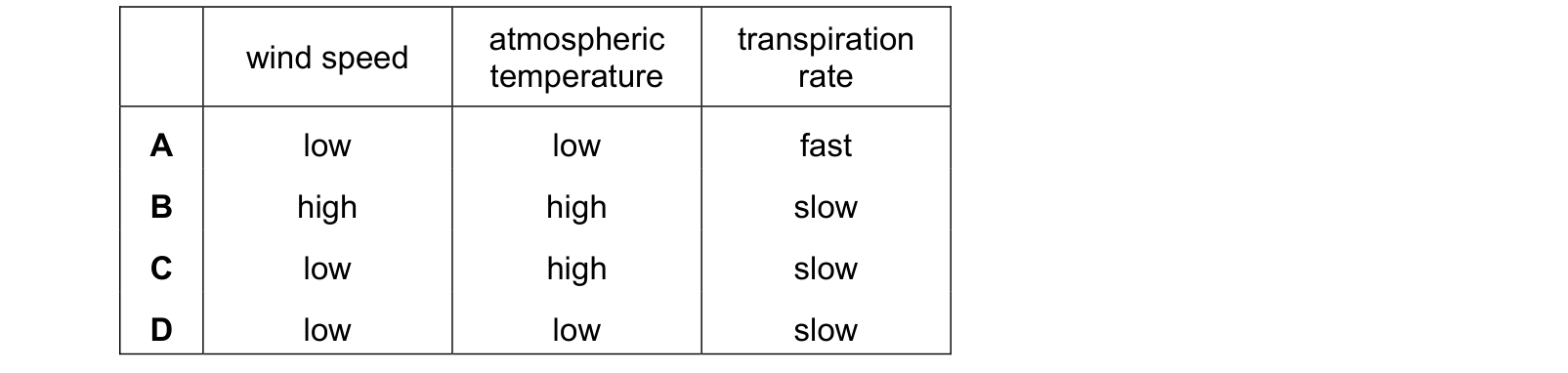
Answer: D.
Both factors point the same way. Low wind lets water vapour accumulate around the stomata, so the concentration gradient between the leaf and the air outside becomes shallow and diffusion slows. Low temperature means less energy for evaporation from the mesophyll surfaces and slower diffusion of the vapour.
The wrong rows each pair conditions with a rate that contradicts them. Low and low with a fast rate (A) reverses the effect entirely. High and high with a slow rate (B) does the same in the other direction, since both of those would speed transpiration up. And low wind with high temperature giving slow (C) mixes one slowing factor with one speeding factor and then commits to slow, which the graph of two opposing influences does not support.
The four factors are worth holding as a set: high temperature, high wind speed and high light intensity all increase transpiration, while high humidity reduces it.
Question 3
The diagram shows some potato tubers. New shoots are beginning to grow.
Sucrose is being translocated from source to sink. Which statement is correct?
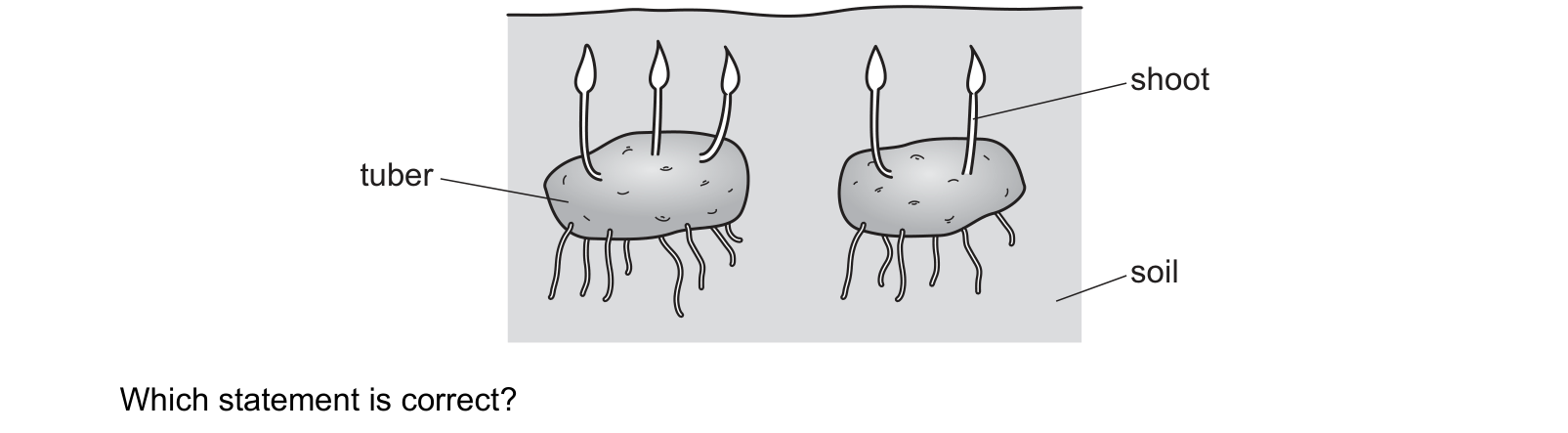
Answer: D.
A source is where sucrose is released into the phloem; a sink is where it is used or stored. New shoots are growing, so they are using sucrose to build new tissue and to respire. That makes them sinks.
The tuber (A) is the source here. It is a store of starch, which is broken down to sucrose and sent out to fuel the new growth. That is why the answer is not simply "the tuber is a sink": a storage organ is a sink when it is filling and a source when it is emptying, and a sprouting potato is emptying.
So the shoots are sources (C) reverses the flow, and the soil (B) is not part of the plant at all and plays no part in translocation.
This seasonal reversal is what makes translocation two-directional, unlike the one-way upward flow in the xylem.
What the syllabus asks for on this topicSyllabus points
Syllabus points
- State the functions of xylem and phloem and describe their positions in roots, stems and leaves.
- Describe the pathway of water from soil to leaf.
- Describe transpiration and explain its importance.
- Investigate and explain the effects of temperature, humidity, wind speed and light intensity on transpiration.
- Explain translocation and the terms source and sink.
Related CIE 0610 Biology topics
Not the topic you were looking for? Describe what you are stuck on in your own words and we will take you to the notes that answer it.