Human nutrition
Contents: 7 sections
A balanced diet
A balanced diet contains all the nutrients in the right proportions and the right amount for the person's age, sex and activity.
| Nutrient | Function | Source |
|---|---|---|
| Carbohydrate | main energy source | bread, rice, potatoes |
| Protein | growth and repair | meat, fish, eggs, beans |
| Fat | energy store, insulation, membranes | butter, oils, nuts |
| Vitamin C | forms connective tissue | citrus fruit |
| Vitamin D | helps the body absorb calcium | oily fish, made in skin in sunlight |
| Calcium | strong teeth and bones | milk, cheese |
| Iron | makes haemoglobin | red meat, liver |
| Fibre | provides bulk so muscles can grip during peristalsis | vegetables, wholegrains |
| Water | solvent for reactions and transport | drinks, most foods |
Deficiency diseases follow directly from the functions:
- Scurvy — too little vitamin C: bleeding gums, poor wound healing.
- Rickets — too little vitamin D or calcium: soft, deformed bones.
- Anaemia — too little iron: not enough haemoglobin, so tiredness and breathlessness.
- Kwashiorkor — too little protein: poor growth and a swollen abdomen.
- Constipation — too little fibre.
Malnutrition means an unbalanced diet, not only too little. Too much energy-rich food leads to obesity, raising the risk of heart disease and type 2 diabetes.
Teeth
Four types, each shaped for a job:
- Incisors — chisel-shaped, at the front, for biting and cutting.
- Canines — pointed, for tearing.
- Premolars and molars — broad with cusps, at the back, for chewing and grinding.
Dental decay happens in a fixed sequence, and questions usually ask for it in order:
- Bacteria and food form a layer of plaque on the teeth.
- Bacteria respire the sugar in the food and produce acid.
- The acid dissolves the enamel.
- Decay reaches the dentine and then the pulp, causing pain.
Prevention follows from each step: brush to remove plaque, eat less sugar so the bacteria produce less acid, and use fluoride toothpaste to strengthen the enamel.
The alimentary canal
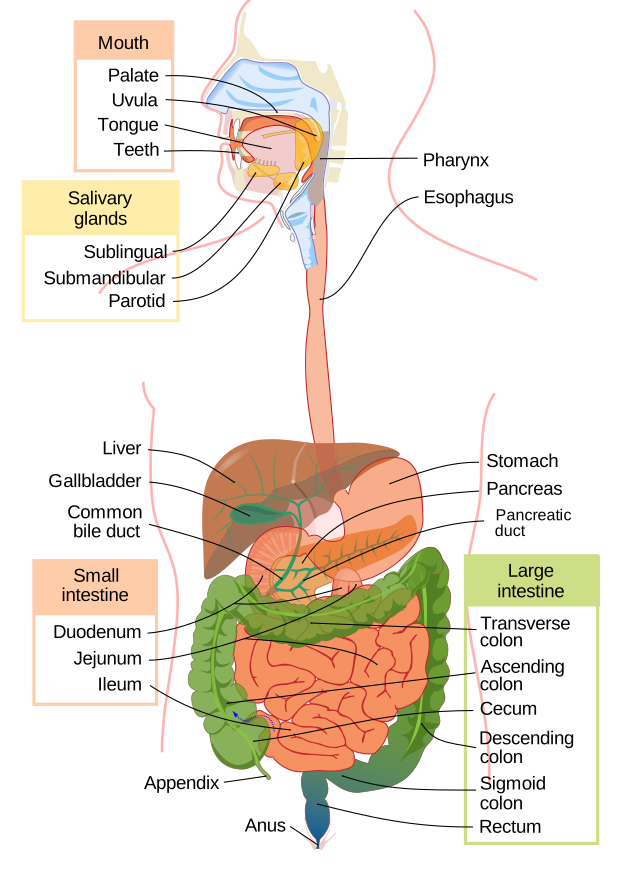
The route, in order: mouth → oesophagus → stomach → small intestine (duodenum then ileum) → large intestine (colon then rectum) → anus.
Two organs are not part of the tube but empty into it:
- Liver — makes bile.
- Pancreas — makes amylase, protease and lipase, and releases them into the duodenum.
The gall bladder stores bile until it is needed.
The five processes
Getting these apart is worth easy marks.
- Ingestion — taking food into the body through the mouth.
- Digestion — breaking large insoluble molecules into small soluble ones.
- Absorption — moving those small molecules into the blood.
- Assimilation — cells taking them up and using them.
- Egestion — passing out undigested food as faeces.
Egestion is not excretion, since the material never entered a cell or took part in metabolism.
Physical and chemical digestion
Physical digestion breaks food into smaller pieces without changing it chemically. Teeth chew it, the stomach churns it, and bile emulsifies fat, breaking large droplets into many small ones. In every case the point is the same: a larger surface area for enzymes to work on, so chemical digestion is faster.
Peristalsis moves food along. Circular muscles contract behind the food and relax in front of it, squeezing it forward in waves.
Chemical digestion uses enzymes to break the bonds in large molecules.
| Enzyme | Made in | Substrate | Products |
|---|---|---|---|
| Amylase | salivary glands, pancreas | starch | maltose |
| Protease (pepsin, trypsin) | stomach, pancreas | protein | amino acids |
| Lipase | pancreas | fats | fatty acids and glycerol |
Bile is not an enzyme. It does two things: it emulsifies fat, and it is alkaline, so it neutralises the acid arriving from the stomach and gives the intestinal enzymes the pH 8 they need. Questions often offer "bile digests fat" as a wrong option.
The stomach produces hydrochloric acid, which gives pepsin its pH 2 optimum and kills most bacteria in food.
Absorption
Absorption happens mainly in the small intestine, which is adapted for it in ways that all come down to surface area and distance:
- Very long, several metres.
- Folded, and covered in millions of villi, each covered in microvilli. Together these give a huge surface area.
- The wall of a villus is one cell thick, so the diffusion distance is short.
- Each villus has a dense capillary network, which carries absorbed molecules away and keeps the concentration gradient steep.
- Each villus has a lacteal, which absorbs fatty acids and glycerol.
Glucose and amino acids pass into the capillaries; fatty acids and glycerol pass into the lacteal. Most absorption is by diffusion, but when the concentration in the gut has fallen below that in the blood, active transport finishes the job, which is why the cells lining a villus are full of mitochondria.
The colon absorbs water, and it is the failure of this step that causes diarrhoea.
Check you have it
Question 1
The diagram shows part of the alimentary canal. Which row correctly identifies the structures labelled J to M? Each answer gives, in order: J; K; L; M.
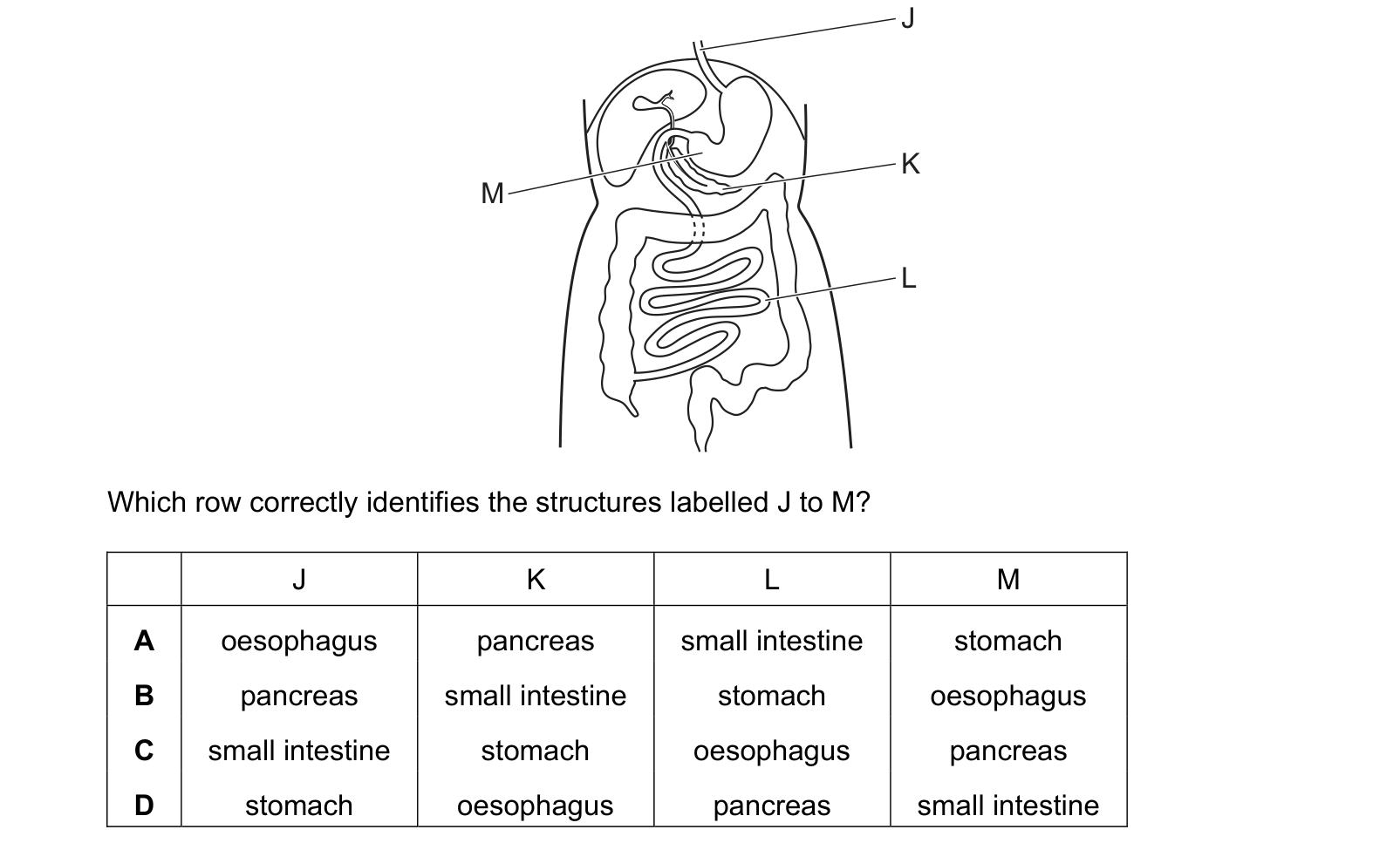
Answer: A.
J is the tube running down from the top into the stomach, so it is the oesophagus.
M is the large curved sac it empties into, the stomach.
K is the elongated structure lying just below and behind the stomach, the pancreas. It releases amylase, protease and lipase into the duodenum, and insulin into the blood.
L is the long coiled tube filling the lower abdomen, the small intestine, where most digestion is completed and most absorption happens.
The wrong rows are all rotations of the same four names, so getting any one label right by position eliminates most of them.
The order of the canal itself settles J and M: food goes down the oesophagus into the stomach, so the tube must be J and the sac must be M.
Question 2
The table shows some different components in a balanced diet. Which row correctly matches the components to the reasons why they are needed? Each answer gives, in order: vitamin D; water; fats.
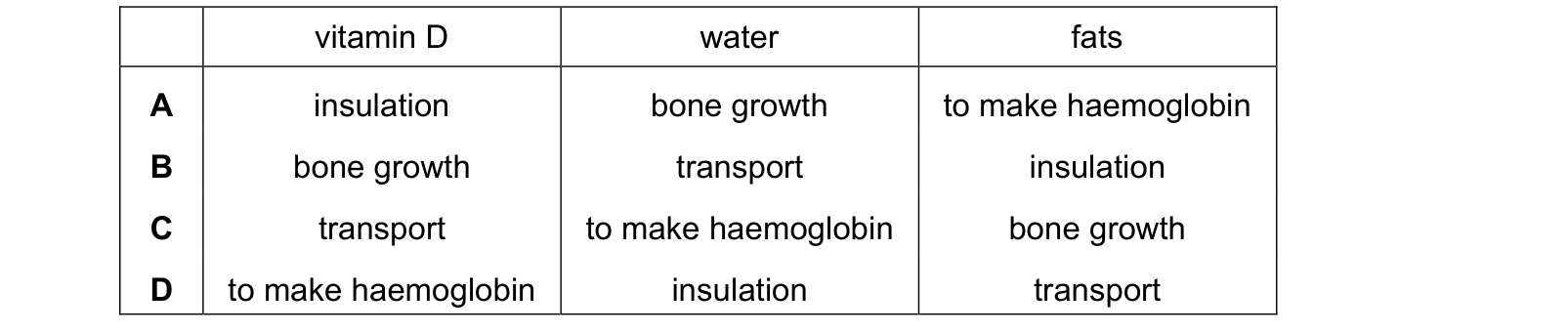
Answer: B.
Vitamin D: bone growth. It allows the body to absorb calcium from food, and calcium is what hardens bones and teeth. A shortage causes rickets.
Water: transport. Blood plasma is mostly water, and dissolved substances such as glucose, amino acids, urea and mineral ions travel in it. Water is also the solvent every reaction in the body happens in.
Fats: insulation. A layer of fat under the skin reduces heat loss. Fat is also a concentrated energy store and protects organs.
The wrong rows shuffle these three between the components, and one adds a fourth job that belongs to nobody here: making haemoglobin requires iron, which is not one of the components listed.
Working out one component with certainty is usually enough, since each appears in a different position across the rows.
Question 3
Which features of the human body protect against pathogens in food? Each answer gives, in order: red blood cells; stomach acid; white blood cells.
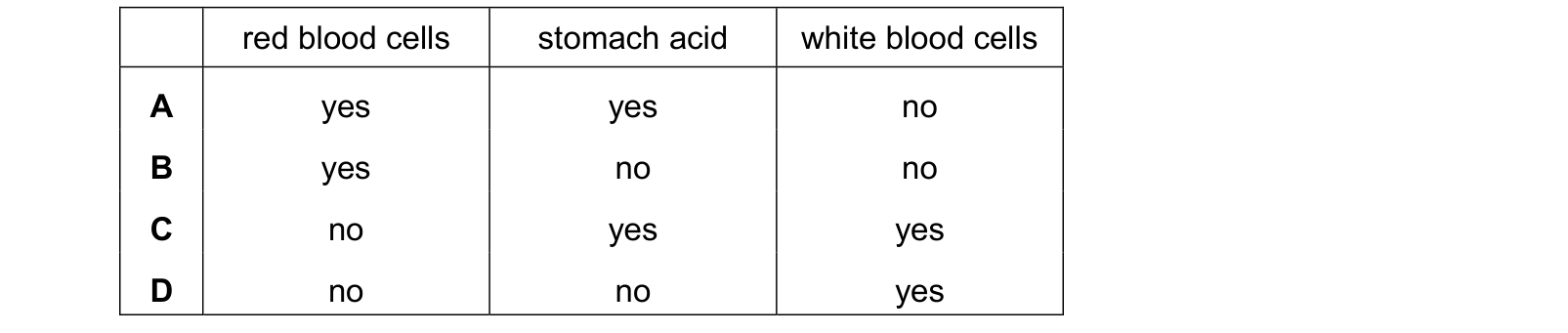
Answer: C.
Stomach acid is a chemical barrier. The hydrochloric acid gives a pH of about 2, which kills most bacteria swallowed with food or drink, before they reach the intestines.
White blood cells deal with anything that gets past. Some engulf and digest pathogens by phagocytosis; others, the lymphocytes, produce antibodies that mark them for destruction.
Red blood cells have no role in defence at all. Their job is carrying oxygen, bound to haemoglobin, and they have no nucleus, which is part of what makes room for more haemoglobin.
That division is the point of the question: the two kinds of blood cell do entirely different jobs, and only one of them is part of the immune system.
What the syllabus asks for on this topicSyllabus points
Syllabus points
- Describe what makes a balanced diet and the sources and functions of the main nutrients.
- Describe the effects of malnutrition.
- Identify the organs of the alimentary canal and describe their functions.
- Describe the types of human teeth and the causes and prevention of dental decay.
- Describe physical and chemical digestion and the roles of the digestive enzymes.
- Describe absorption and explain how the small intestine is adapted for it.
Related CIE 0610 Biology topics
Not the topic you were looking for? Describe what you are stuck on in your own words and we will take you to the notes that answer it.