19 past-paper questions on this unit. Five of them are below. Answer on the page: each one is marked the moment you pick, the correct option is shown whether or not you found it, and the full explanation opens either way.
CIE 0654 Co-ordinated SciencesPaper 1 and Paper 2 MCQsFree account
Gas exchange in humans: five questions to try now
Real past-paper questions, the answer key from the mark scheme, and the explanation that goes with it. No account needed to answer them.
Question 1
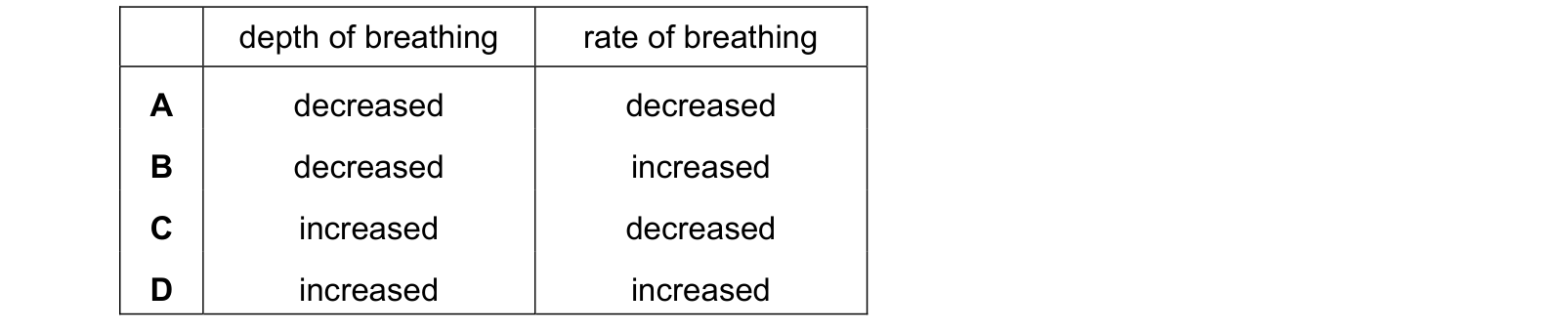
A person ran up as many stairs as they could in one minute. What would be the effect on their breathing? Each answer gives, in order: depth of breathing; rate of breathing.
Answer: D.
Running up stairs makes the leg muscles respire far faster, so they demand more oxygen and produce more carbon dioxide. The brain detects the rise in carbon dioxide in the blood and drives the diaphragm and intercostal muscles harder, so each breath becomes deeper and the breaths come more often, moving much more air through the lungs every minute. The row giving shallower but faster breathing is the tempting one, because rapid breathing after exercise sounds shallow, but shallow breaths waste a larger share of each breath on air that never reaches the alveoli and would deliver less oxygen just when the demand is highest. Any row with breathing slowing down reverses the response, since that would let carbon dioxide build up further at the worst possible moment.
Question 2
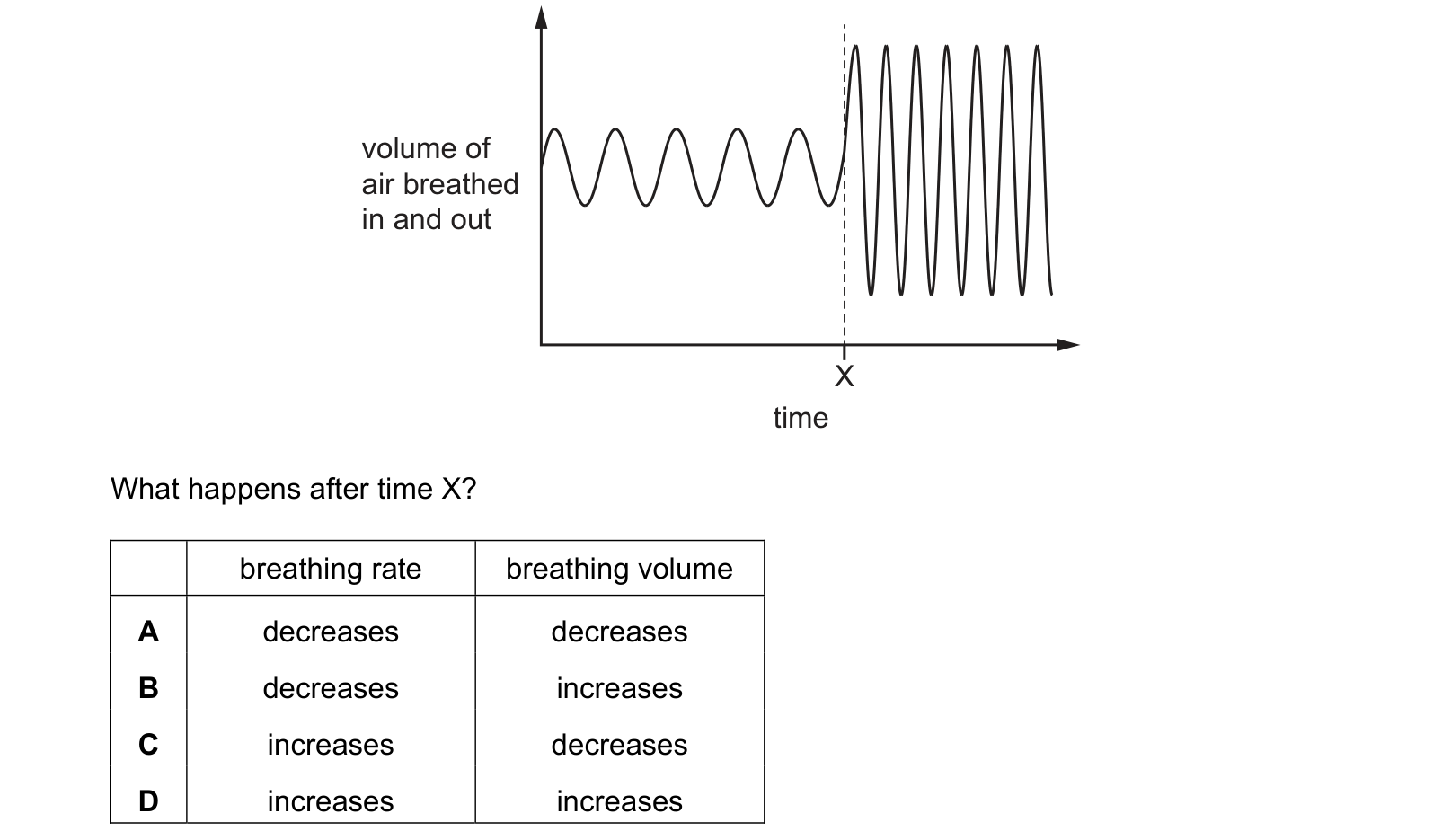
The graph shows the volume of air breathed in and out over a period of time. What happens after time X? Each answer gives, in order: breathing rate; breathing volume.
Answer: D.
Breathing rate is read from how many complete waves fit into a given time, and breathing volume from the height of each wave between its trough and its peak. After X the waves are packed closer together, so each cycle takes less time and more breaths happen every minute, and they also reach higher peaks and deeper troughs, so each breath moves more air. Both quantities therefore increase, which is exactly what exercise does when muscles demand more oxygen and produce more carbon dioxide. The two rows that call the breathing rate a decrease have misread crowded waves as slow ones, when crowding means the opposite. The row that keeps the rate increasing but calls the volume a decrease would need the peaks to flatten after X, whereas the trace plainly grows taller.
Question 3
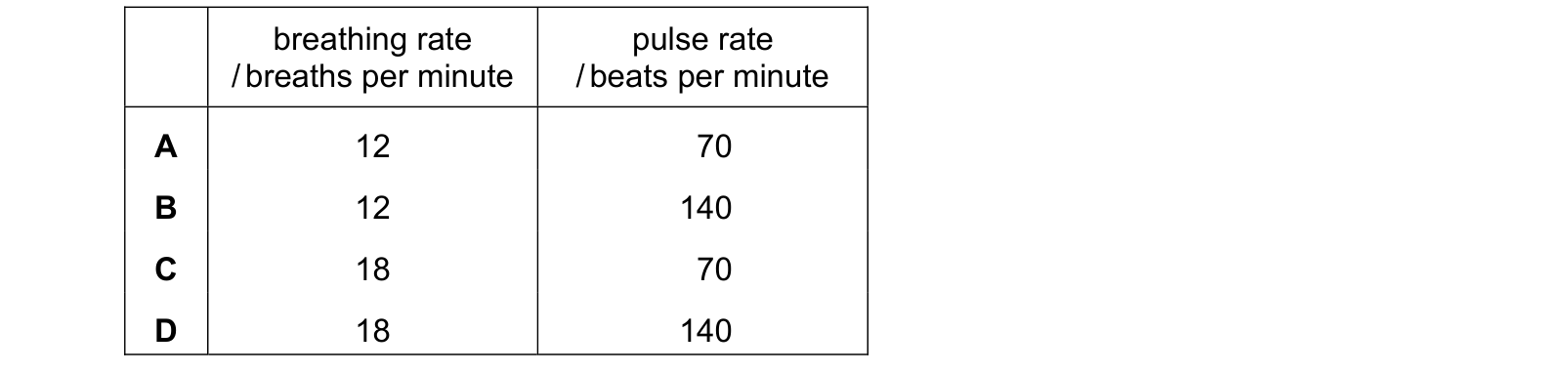
Which row shows a person’s response to a ‘fight or flight’ situation? Each answer gives, in order: breathing rate / breaths per minute; pulse rate / beats per minute.
Answer: D.
A fight or flight response is driven by adrenaline, which raises the breathing rate and the pulse rate together so that the muscles receive more oxygen and glucose. Resting values are around 12 breaths and about 70 beats each minute, so the row combining the raised breathing rate of 18 with the raised pulse of 140 is the one showing the response. The row pairing 12 breaths with 70 beats gives two resting values and describes someone perfectly calm. The row with 12 breaths and 140 beats has the heart racing while breathing stays at rest, which would circulate blood the lungs had not had time to oxygenate. The row with 18 breaths and 70 beats raises the breathing alone, leaving the heart unable to deliver that extra oxygen any faster.
Question 4
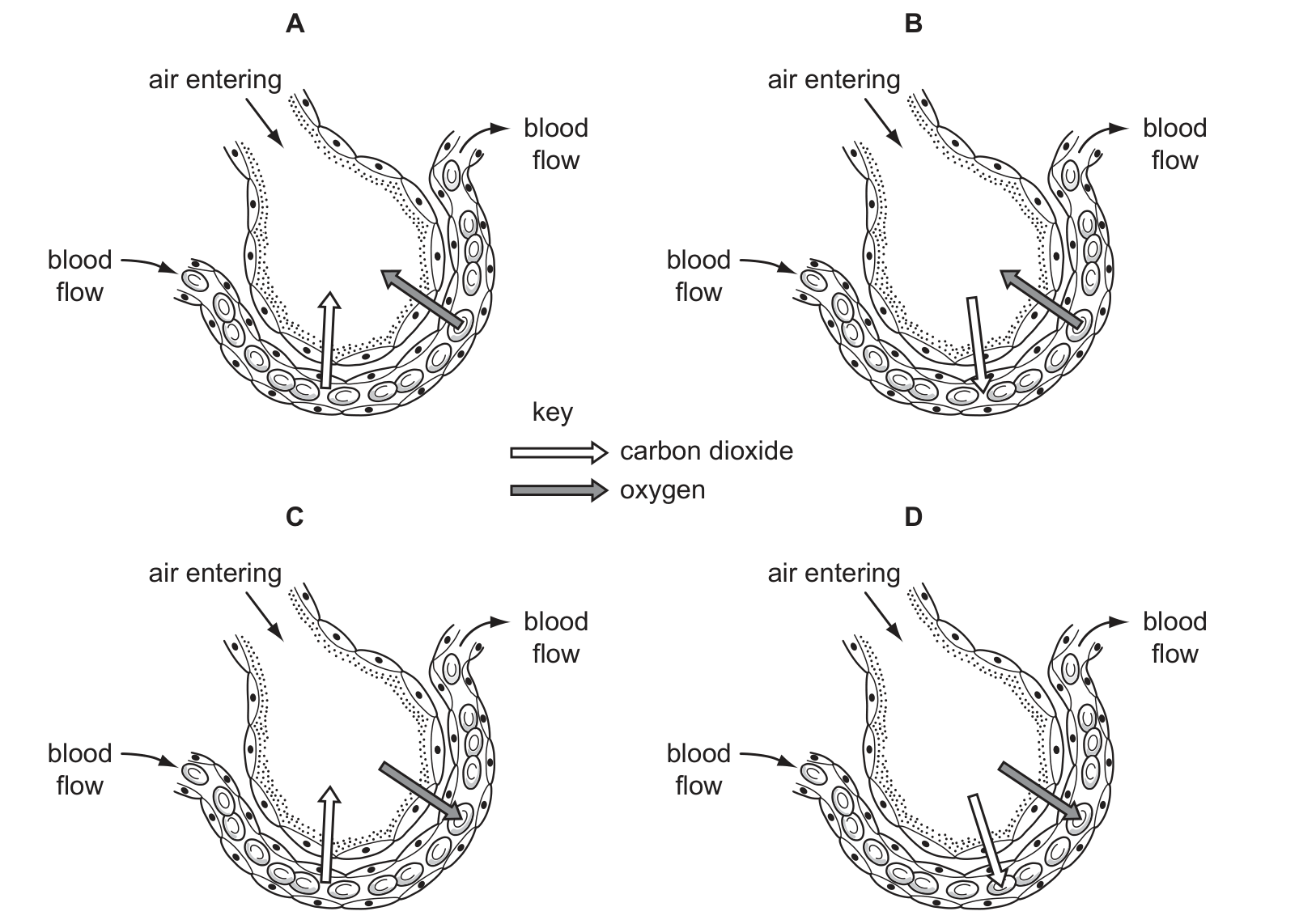
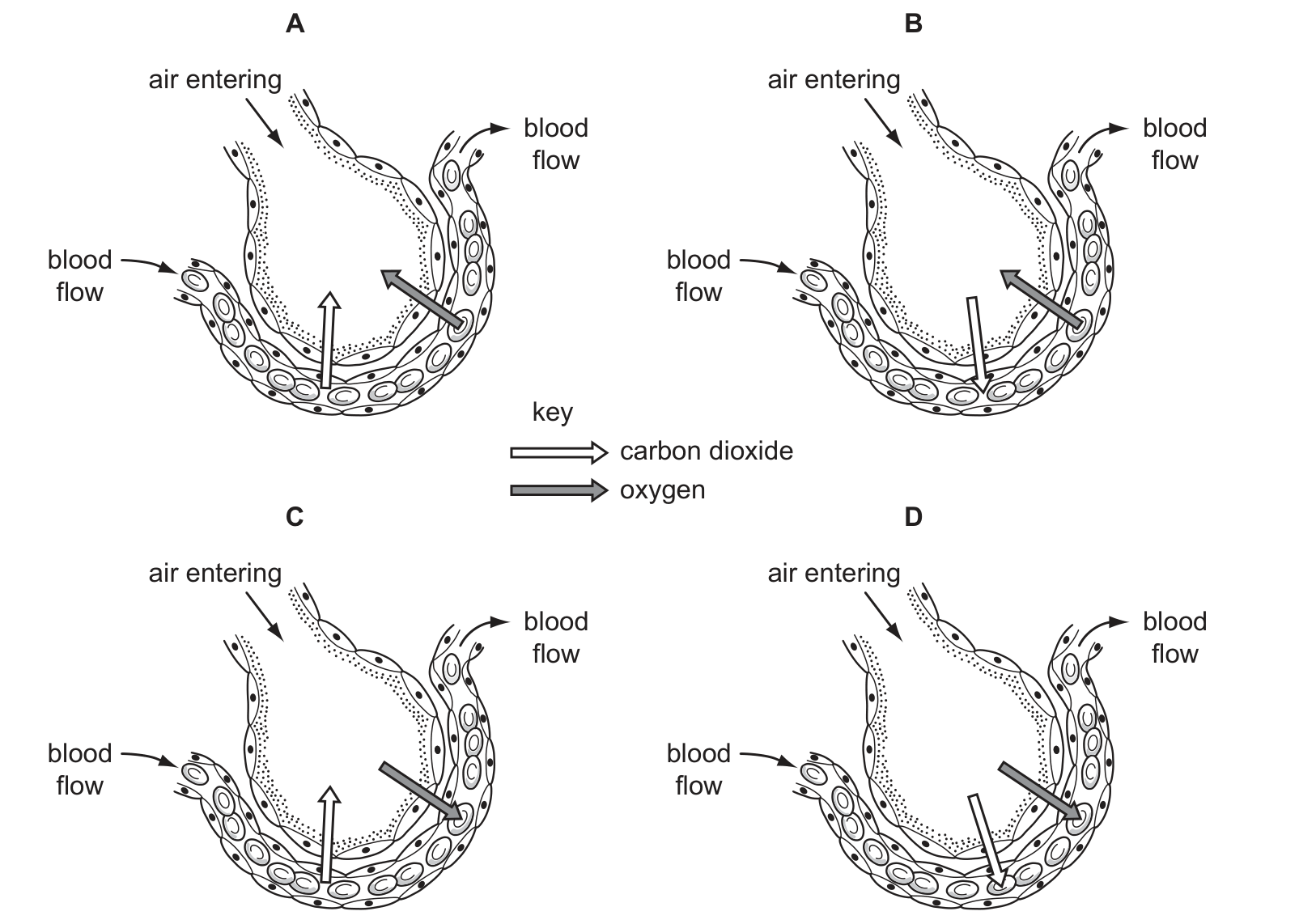
Which diagram correctly shows the diffusion of carbon dioxide and oxygen between an alveolus and a capillary? Use the source image for S21 Paper 12, question 2.
Answer: C.
Gases cross the alveolar wall by diffusion, each moving from where it is more concentrated to where it is less. The air in the alveolus is rich in oxygen and low in carbon dioxide while the blood arriving from the body is the reverse, so oxygen must be drawn from the alveolus into the capillary and carbon dioxide pushed from the capillary into the alveolus. The diagram with both arrows reversed sends oxygen out of the blood and carbon dioxide into it, which is backwards for each gas separately. The diagram with both arrows pointing into the capillary loads the blood with carbon dioxide and leaves the body no route to breathe the gas out. The diagram with both arrows leaving the blood gets the carbon dioxide right but drains oxygen out of the capillary, leaving the blood nothing to deliver to the tissues.
Question 5
Which diagram correctly shows the diffusion of carbon dioxide and oxygen between an alveolus and a capillary? Use the source image for S21 Paper 13, question 2.
Answer: C.
Gases cross the alveolar wall by diffusion, each moving from where it is more concentrated to where it is less. The air in the alveolus is rich in oxygen and low in carbon dioxide while the blood arriving from the body is the reverse, so oxygen must be drawn from the alveolus into the capillary and carbon dioxide pushed from the capillary into the alveolus. The diagram with both arrows reversed sends oxygen out of the blood and carbon dioxide into it, which is backwards for each gas separately. The diagram with both arrows pointing into the capillary loads the blood with carbon dioxide and leaves the body no route to breathe the gas out. The diagram with both arrows leaving the blood gets the carbon dioxide right but drains oxygen out of the capillary, leaving the blood nothing to deliver to the tissues.
These questions are drawn from past CIE 0654 Co-ordinated Sciences papers and filtered to gas exchange in humans. You answer, you find out immediately whether you were right, and you get the reasoning for the correct option and for each distractor. Wrong answers go to a mistakes locker so you can come back to exactly those.
Practice is free. You need an account only so your progress and your mistakes are still there next time.
These are the errors that cost marks on gas exchange in humans, taken from our own topic notes. Read them before you practise and you will recognise the traps in the questions.
Putting the trachea before the larynx, or bronchioles before bronchi.
Saying expired air contains no oxygen.
Saying inspired air is dry and expired air is moist. Inspired air is variable; expired air is saturated.
Saying nitrogen is used up in the lungs.
Saying cilia make mucus, or that goblet cells sweep it away.
Saying cilia move mucus down into the lungs.
Saying alveoli walls are thin "so the gases can get through", instead of saying the diffusion distance is short.
Leaving the blood supply out of the list of alveolar adaptations.