22 past-paper questions on this unit. Five of them are below. Answer on the page: each one is marked the moment you pick, the correct option is shown whether or not you found it, and the full explanation opens either way.
CIE 0654 Co-ordinated SciencesPaper 1 and Paper 2 MCQsFree account
Transport in animals: five questions to try now
Real past-paper questions, the answer key from the mark scheme, and the explanation that goes with it. No account needed to answer them.
Question 1
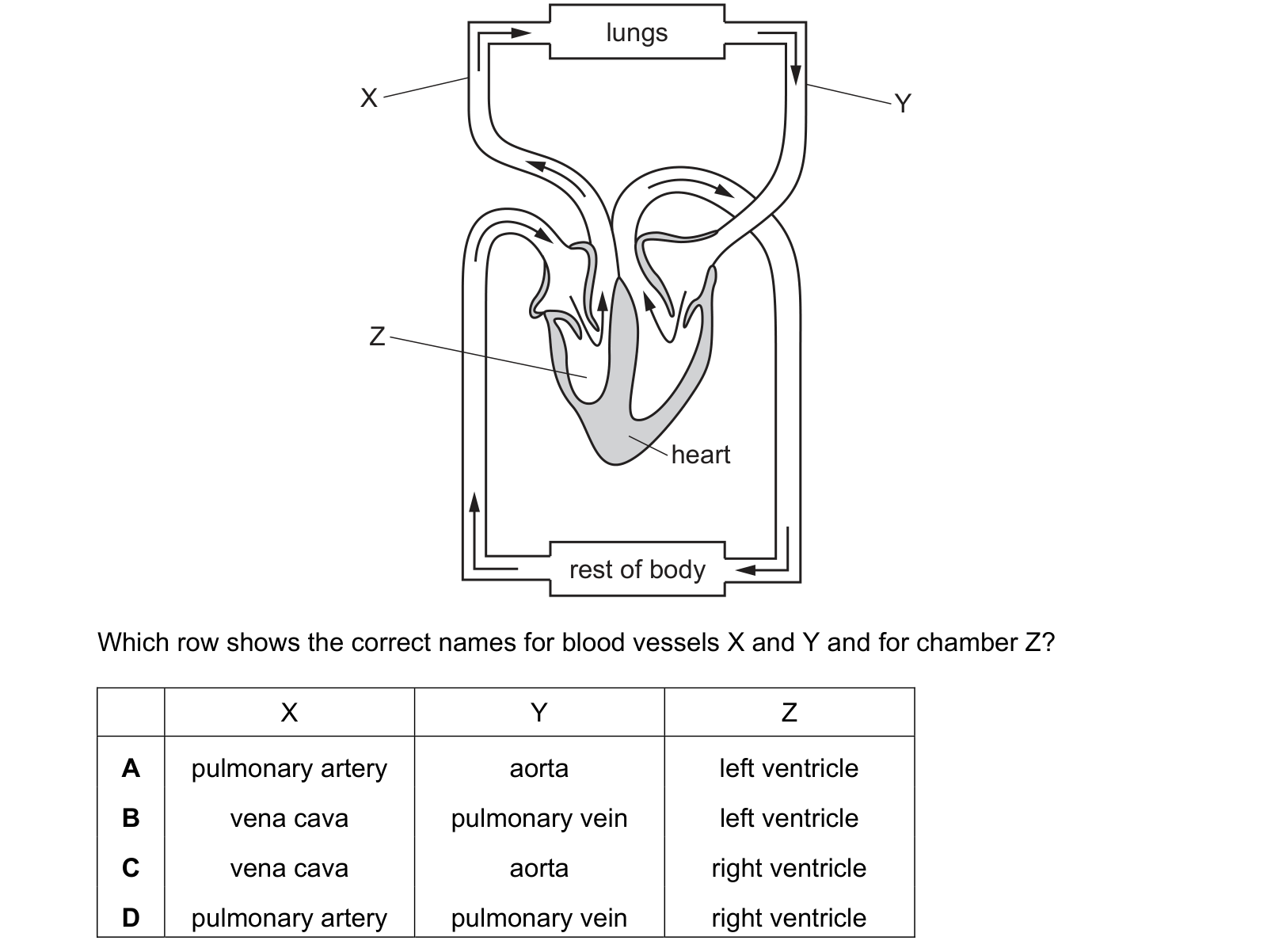
The diagram shows the circulatory system of a mammal. Which row shows the correct names for blood vessels X and Y and for chamber Z? Each answer gives, in order: X; Y; Z.
Answer: D.
X carries blood from the heart up to the lungs, and every vessel leaving the heart is an artery, so X is the pulmonary artery. Y brings that blood back down from the lungs into the heart, and a vessel returning blood to the heart is a vein, so Y is the pulmonary vein. Z labels the chamber from which X leaves, and the chamber pumping blood to the lungs is the right ventricle. The two rows naming X the vena cava pick the vessel that returns blood from the body, whereas the arrow on X points away from the heart and towards the lungs. The row naming Y the aorta and Z the left ventricle describes the other circuit entirely, since the aorta leaves the left ventricle for the body while Y is drawn arriving from the lungs.
Question 2
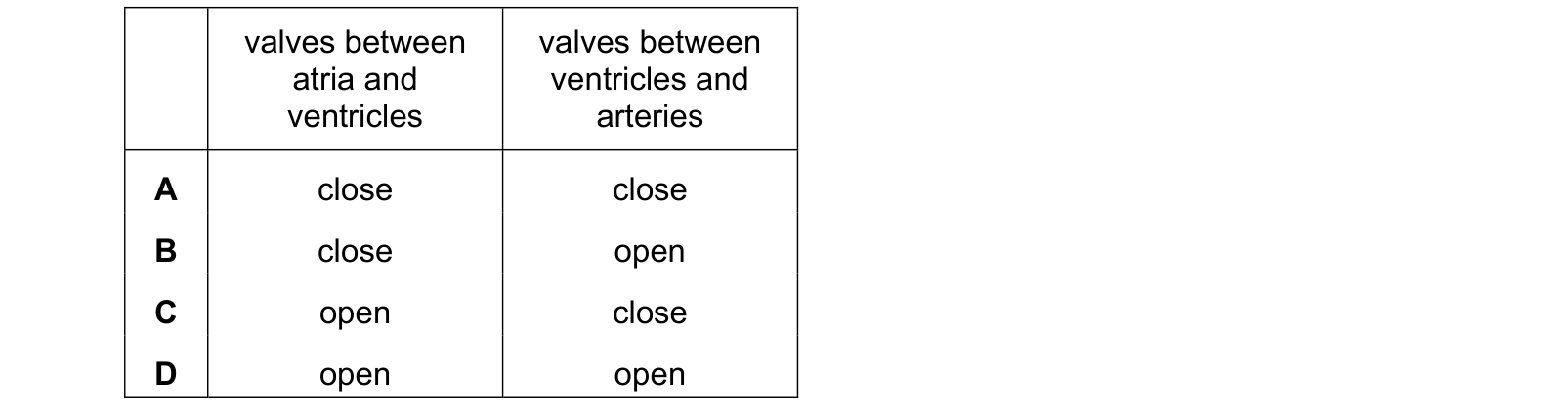
What happens to the valves in the heart when the ventricles contract? Each answer gives, in order: valves between atria and ventricles; valves between ventricles and arteries.
Answer: B.
When the ventricles contract, the pressure inside them rises above the pressure in the atria and above the pressure in the arteries leaving the heart. Blood pushes valves open in the direction of falling pressure, so the higher ventricular pressure snaps the atrioventricular valves shut, preventing backflow into the atria, and at the same time forces the semilunar valves open so blood is ejected into the aorta and the pulmonary artery. The row with both sets of valves closed is tempting because it seems to protect the heart from any backflow at all, but with every valve shut the blood would have nowhere to go and the contraction would achieve nothing. The row with the atrioventricular valves open describes the earlier stage, when the ventricles are relaxed and filling from the atria.
Question 3
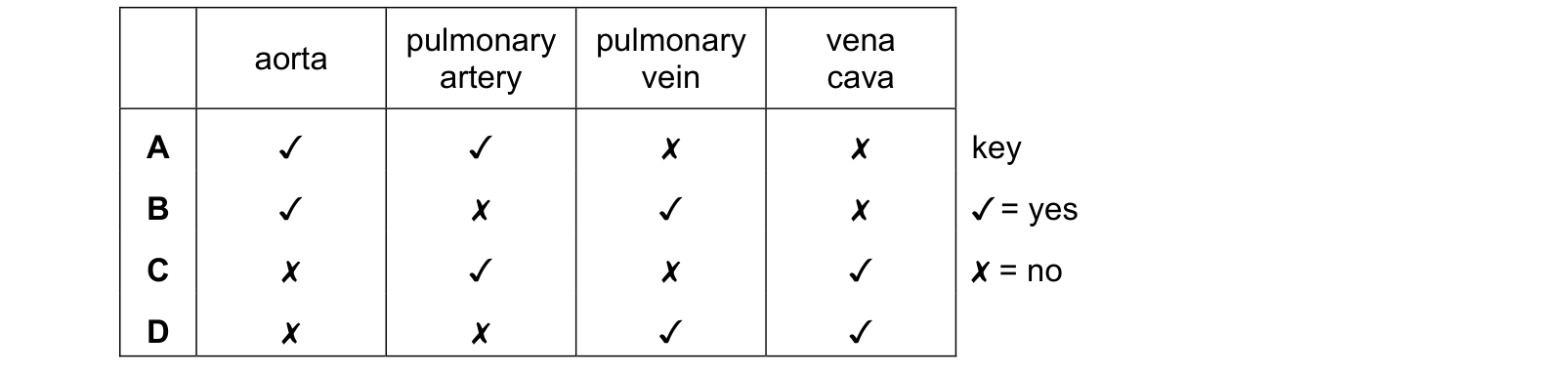
Which vessels carry blood towards the heart? pulmonary pulmonary vena aorta artery vein cava Use the source image for S24 Paper 23, question 7.
Answer: D.
A vein carries blood towards the heart and an artery carries it away, so the two vessels to tick are the pulmonary vein, returning blood from the lungs, and the vena cava, returning it from the body. The aorta and the pulmonary artery both leave the heart, one for the body and one for the lungs, so both columns must be left unticked. The two rows that tick the aorta have the largest artery in the body flowing into the heart it is pumped out of. The row that ticks the pulmonary artery alongside the vena cava mixes one vessel of each kind, and the pulmonary artery is the tempting error because it carries deoxygenated blood, which students associate with veins, even though it flows out of the heart.
Question 4
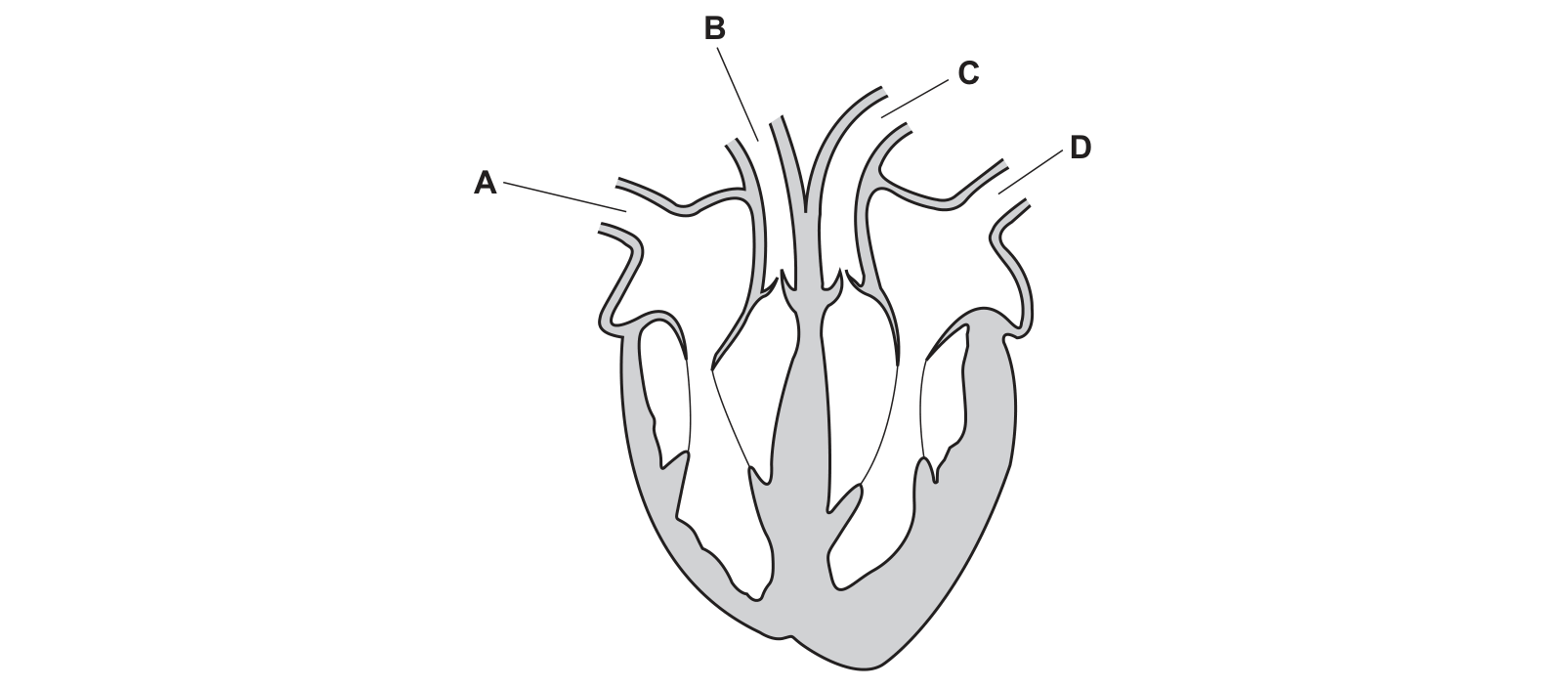
The diagram shows a section through a mammalian heart. Which vessel is the pulmonary vein? Use the source image for W21 Paper 12, question 7.
Answer: D.
The pulmonary vein brings oxygenated blood from the lungs into the left atrium, so it is a vessel entering the heart rather than leaving it, and it joins the atrium on the side that pumps blood out to the body. The label on the lower vessel joining the chamber on the right of the drawing marks that vein. The labelled vessel on the opposite side, entering the other atrium, is the vena cava, which returns deoxygenated blood from the body. The two labelled vessels rising from the top of the heart are the pulmonary artery and the aorta, and both carry blood away from a ventricle, so neither can be a vein whatever the blood inside them is carrying.
Question 5
The arrows in the diagram represent blood vessels. Which vessel is the pulmonary vein? Use the source image for M23 Paper 12, question 7.
Answer: B.
A vein carries blood towards the heart and an artery carries it away, so the pulmonary vein is the vessel bringing blood from the lungs back into the heart. The arrow drawn from the lungs down into the heart is that vessel. The arrow running upwards from the heart to the lungs is the pulmonary artery, and it is the distractor most often taken, because it carries deoxygenated blood and students expect the word vein to follow the oxygen content rather than the direction of flow. The arrow leading from the heart out to the kidneys is the renal artery and the arrow returning from the kidneys is the renal vein, and although the second of those really is a vein, both of them serve the kidneys rather than the lungs.
These questions are drawn from past CIE 0654 Co-ordinated Sciences papers and filtered to transport in animals. You answer, you find out immediately whether you were right, and you get the reasoning for the correct option and for each distractor. Wrong answers go to a mistakes locker so you can come back to exactly those.
Practice is free. You need an account only so your progress and your mistakes are still there next time.
These are the errors that cost marks on transport in animals, taken from our own topic notes. Read them before you practise and you will recognise the traps in the questions.
Defining an artery as a vessel carrying oxygenated blood, which fails for the pulmonary artery.
Saying the pulmonary vein carries deoxygenated blood.
Sending blood to an organ down a vein, for example writing "aorta to renal vein".
Saying the left ventricle is thicker because it pumps more blood. It pumps at higher pressure.
Saying valves are opened by muscles rather than by pressure differences.
Saying both sets of valves are closed while the ventricles contract.
Giving arteries valves.
Saying capillary walls are thin "to let blood through". They are one cell thick to shorten the diffusion distance.